

Natalie McNally murder: Court told of bus trip by masked man
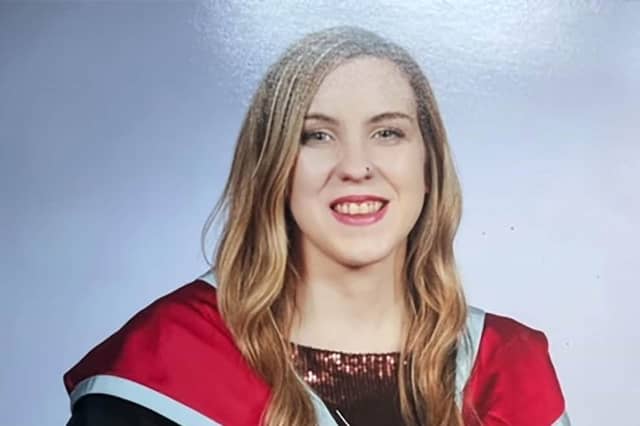

The murder of mum-to-be Natalie McNally was allegedly a meticulously planned, “sophisticated, calculating and cool headed plot” to kill her and cover her killer’s tracks, a judge heard today (Thursday, February 2).
“Every moment has been carefully thought through and it’s only due to painstaking police work and sophisticated cyber evidence that he hasn’t got away with it,” declared a prosecuting lawyer.
With grieving friends and relatives sitting in the public gallery and more than 100 more watching proceedings online, 31-year-old Stephen McCullagh, from Woodland Gardens in Lisburn, appeared at Lisburn Magistrates Court by videolink from police custody where he was accused of the murder of Natalie McNally on 18 December last year.
Ms McNally, 32, was 15 weeks pregnant when she was stabbed in her home in Lurgan on December 18.
It is understood that McCullagh was arrested the following day but was freed and then formally de-arrested on Christmas Eve.
With new evidence and lines of enquiry “coming in every hour,” the police view changed, however, and he was re-arrested on January 31.
Giving evidence Detective Chief Inspector Magennis explained how McCullagh was downgraded from suspect to witness based on a belief that he live-streamed a six hour, online gaming session at the time Natalie was brutally killed.
However the court heard that recent evidence from the cyber crime unit and the NCA revealed that McCullagh had pre-recorded the video which he had broadcast on his YouTube channel so he was re-arrested as a suspect and questioned until 3am this morning.
Describing the investigation as “complex,” DCI Magennis told the court that according to the police case thus far the alleged killer, carrying a “distinctive” Asda bag for life, took a bus from Dunmurry to Lurgan, all the while taking “careful” steps to conceal his face using a hood and scarf.
He said the quality of the CCTV on the bus was excellent and from that, he claimed that a black rucksack could be seen inside the Asda bag.
The senior detective also outlined that throughout the 90 minute journey, the man sits “motionless, except to check his face is covered,” including when he “awkwardly” takes a drink from a bottle of Coke.
Getting off the bus at the stop closest to the victim’s house, the bag carrying, masked man then walks to Ms McNally’s house where he spent 40 minutes and after “completely changing his clothes,” he took a taxi to Lisburn and was dropped close to McCullagh’s house.
Conceding that only the man’s nose was visible, the DCI said the quality of the cctv from the bus was of such a standard police believed facility mapping experts can use it and claimed further that the gait, stride and build of the man in the CCTV, before and after the stabbing, is the same.
DCI Magennis said the driver had shown police where he dropped the fare and while he wasn’t familiar with Lisburn, the GPRS in his taxi confirmed the location.
The officer said while McCullagh’s phone couldn’t be used to put him at the scene, the device showed “absolutely no activity whatsoever” from 6pm until it was “swiped open” at 11.16, which was just three minutes after the taxi dropped its fare nearby.
“That’s strange behaviour in itself,” said the police officer, “that there’s no movement or activity for five hours at a significant time.”
Turning to the YouTube broadcast, DCI Magennis said that on the day of the murder McCullagh told his 37,000 followers he would be broadcasting live that evening but that he was “having trouble with his set up” so while he would be streaming, he would not be interacting with viewers’ comments.
It was this video, he told the court, which had initially provided McCullagh “an alibi for the time that she was attacked and murdered” and was the reason McCullagh’s status changed from suspect to witness.
Even when he was downgraded, and with police urging him to help as he was the only person who had first hand experience of the murder scene as he had discovered Natalie’s body, McCullagh refused to co-operate with investigators, the court heard.
The investigation also revealed that last week, McCullagh had left his phone at the home of Natalie’s parents, leaving it surreptitiously on record for 40 minutes as, according to the officer, he tried to ascertain details about the investigation and whether they believed he was a suspect.
McCullagh was upgraded back to suspect status after “highly trained experts in cyber crime,” along with the NCA, ascertained the YouTube stream had actually been pre-recorded.
DCI Magennis said that given McCullagh’s job as a journalist, police had to get a special warrant in order to seize his computer and other electronic devices which haben he been sent for examination.
Arrested and questioned as a suspect, McCullagh admitted he had recorded the streaming video five days before the murder but claimed that in the night Natalie’s was stabbed to death, he had been drinking and fell asleep.
He did also admit, the court heard, that someone came to his house at the same time the taxi dropped its fare nearby and he “proffered a few names” as to who it might have been.
Commenting that the police have had “an enormous response from the public” with evidence constantly arriving, DCI Magennis said police were objecting to McCullagh being freed as he may interfere with witnesses or the investigation itself, arguing that potential witnesses may not come forward if he is freed.
There was also a risk of further offences and of him fleeing.
“Over the last six weeks he has behaved in such a way that he displayed a confidence that he had got away with it,” said a prosecuting lawyer, “he was liaising with the family, he has been at their home and he will be absolutely desperate now.
“He has shown that he is capable of deception beyond imagination and there are absolutely no bail conditions that could alleviate the risk posed here,” declared the lawyer.
District Judge Rosie Watters told the court “I don’t know if I have ever come across a case that is so complex… if the police are right this was a cold blooded attack which has meticulous planning.”
“If he can carry out an attack like this, if the police case is right, then who knows what else he is capable of and the planning involves a knowledge of technology that’s far above my head.”
DJ Watters said she was concerned about all three grounds to object to bail - further offences, absconding and McCullagh interfering with the investigation so she was refusing bail.
Remanding the alleged killer into custody she adjourned the case to 24 February.